
How Digitalised AWD Technology is Transforming Rice Production in Modern Agriculture
The current global agricultural landscape is facing a roadblock. How do we feed a growing population yet reduce a significant environmental footprint? It’s a major concern that modern agriculture has to address urgently.

Fig 1. RYNAN MethanEYE and AWD+ in a rice field in Binh Duong, Vietnam
When we shift our eyes to agricultural sources that are significant emitters of methane gas, rice cultivation comes up as a common topic. Despite being a staple food for over half the world’s population, traditional rice farming is undeniably a leading source of methane emissions.
Methane gas emissions from rice paddy fields
What is so bad about Methane gas? Methane is a greenhouse gas (GHG) that is 80 times more powerful than Carbon Dioxide as a GHG, and is a precursor to tropospheric ozone, a climate pollutant. Hence, reducing methane emissions is a key step towards sustainable agriculture.
Traditionally, rice paddies are kept under continuous flooding (CF), creating anaerobic soil conditions that enable methanogenic bacteria to thrive and produce excess amounts of methane gas. Furthermore, heavy reliance on the constant flooding of the rice paddies consumes a tremendous amount of water, a resource becoming increasingly volatile due to climate change. Evidently, a solution that is able to track water levels and usage in rice paddy fields is crucial to help farmers better manage, plan, and optimise how much water to allocate to the rice fields during different stages of rice growth.
The water management method of Alternate Wetting and Drying (AWD) offers a promising solution to this problem, and RYNAN Smart Agriculture is able to provide a digitalised Alternate Wetting and Drying (AWD) technological solution.
Mitigating water wastage and methane emissions in Subang, West Java, Indonesia
This case study, conducted by Rhami et al. (2025) in a rice field in Subang, West Java, Indonesia, demonstrated the effectiveness of digitalised AWD technology in enhancing rice farming efficiency. This study highlighted a significant decrease in both methane emissions and water usage under the usage of digitalised AWD technology compared to the use of the traditional CF method.
The team measured the amount of methane gas produced from the rice plants using the two methods: 1) Traditional CF and 2) digitalized AWD technology. In one area of the rice fields where the elevation of the land was lower than in the other parts, water was accumulated and kept the rice plants flooded. In another part of the rice fields, where the elevation of the land was higher and allowed for water drainage, the RYNAN Alternate Wetting and Drying device was installed to carry out the digitalised alternate wetting and drying water management method.

Fig 2. RYNAN AWD+ device used in the rice fields in Subang, West Java, Indonesia
Throughout a period of around 100 days, daily gas sampling was conducted for both areas of the rice fields. The collected methane gas samples were quantified using Gas Chromatography (with a Flame Ionization Detector), and the quantified methane emissions were expressed in terms of kg/ha/day.
Successful results demonstrated
What did the results show? The water management method involving the RYNAN Alternate Wetting and Drying device produced a significantly lower quantity and rate of methane emissions compared to the traditional flooding method.
The area using the traditional CF method showed 292.74kg/ha/day of methane emissions rate. As for the area with the AWD method? Only 34.59/kg/ha/day! Not only did the amount of water consumed in the cultivation process decrease, but the amount of methane emitted from the rice fields also dropped tremendously, decreasing by more than 50%.
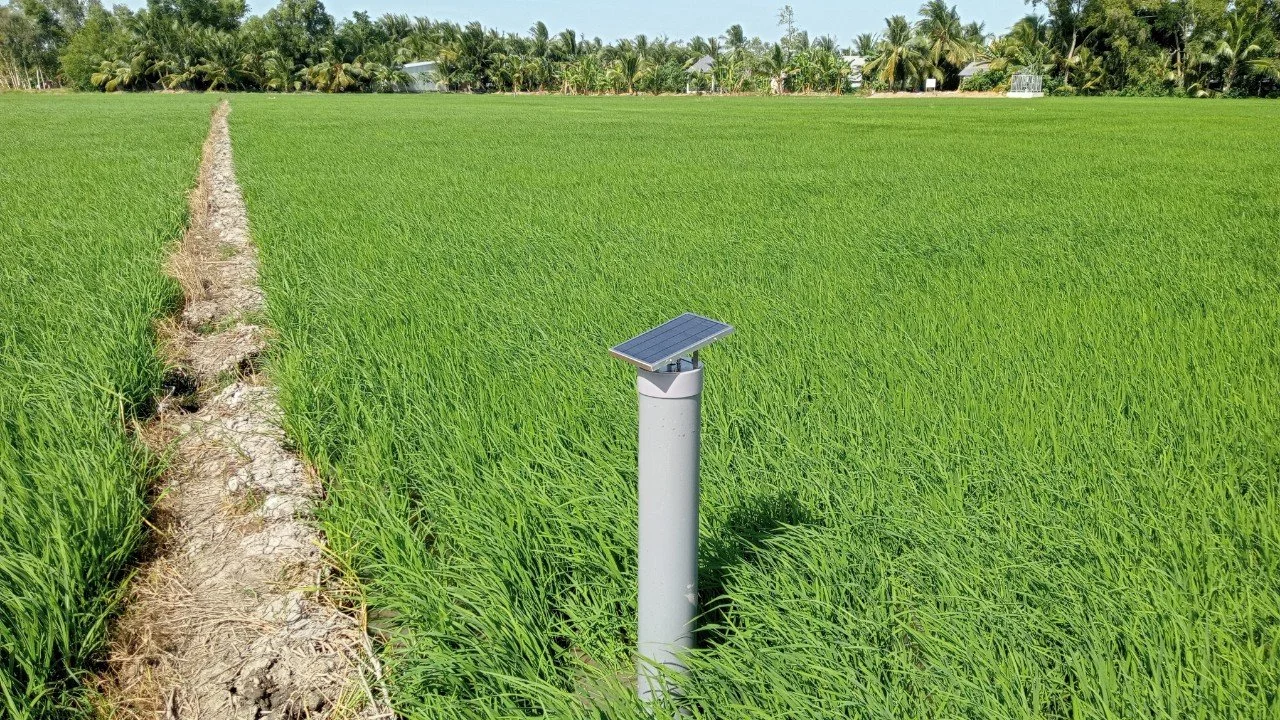
Fig 3. RYNAN AWD+ device in Kien Giang
For sustainable agricultural projects, especially for those involving rice fields and cultivation, this is a positive step taken. In countries like Vietnam, the Philippines, and Indonesia, alternate wetting and drying are increasingly adopted by farmers to better manage their resources while producing a good quality of rice yield. Additionally, the operational efficiencies are equally persuasive.
Digitalising such a water management method means fewer manual checks are needed. AWD devices like that of RYNAN’s incorporate smart sensors that can transmit real-time water level data to another platform for greater accessibility. This means that farmers can access the information away from the farm, and they have a clearer vision of the time frames during which the rice field is flooded or drained.
Digitalised AWD highlights a fundamental shift in how we approach agricultural sustainability. It is about re-evaluating farming operations to further de-risk and unlock new values in the midst of an environment that is increasingly volatile. For investors looking to drive the 2030 Net Zero agenda, supporting IoT-driven agriculture is one of the most effective ways to achieve measurable impacts at a larger, global scale.